
“MULTITASKING”
There is a particular kind of professional pride that surrounds the ability to multitask. In many workplace cultures, it has become a badge of competence. The person who can juggle the most plates simultaneously, who responds to messages mid-meeting, who maintains parallel workstreams across a dozen open browser tabs, is often perceived as more capable, more valuable, more indispensable than someone who works through one thing at a time. Job descriptions request it. Performance reviews reward it. Candidates advertise it.
It is also a fiction. Multitasking, in reality, is switch tasking.
What Your Brain Is Actually Doing
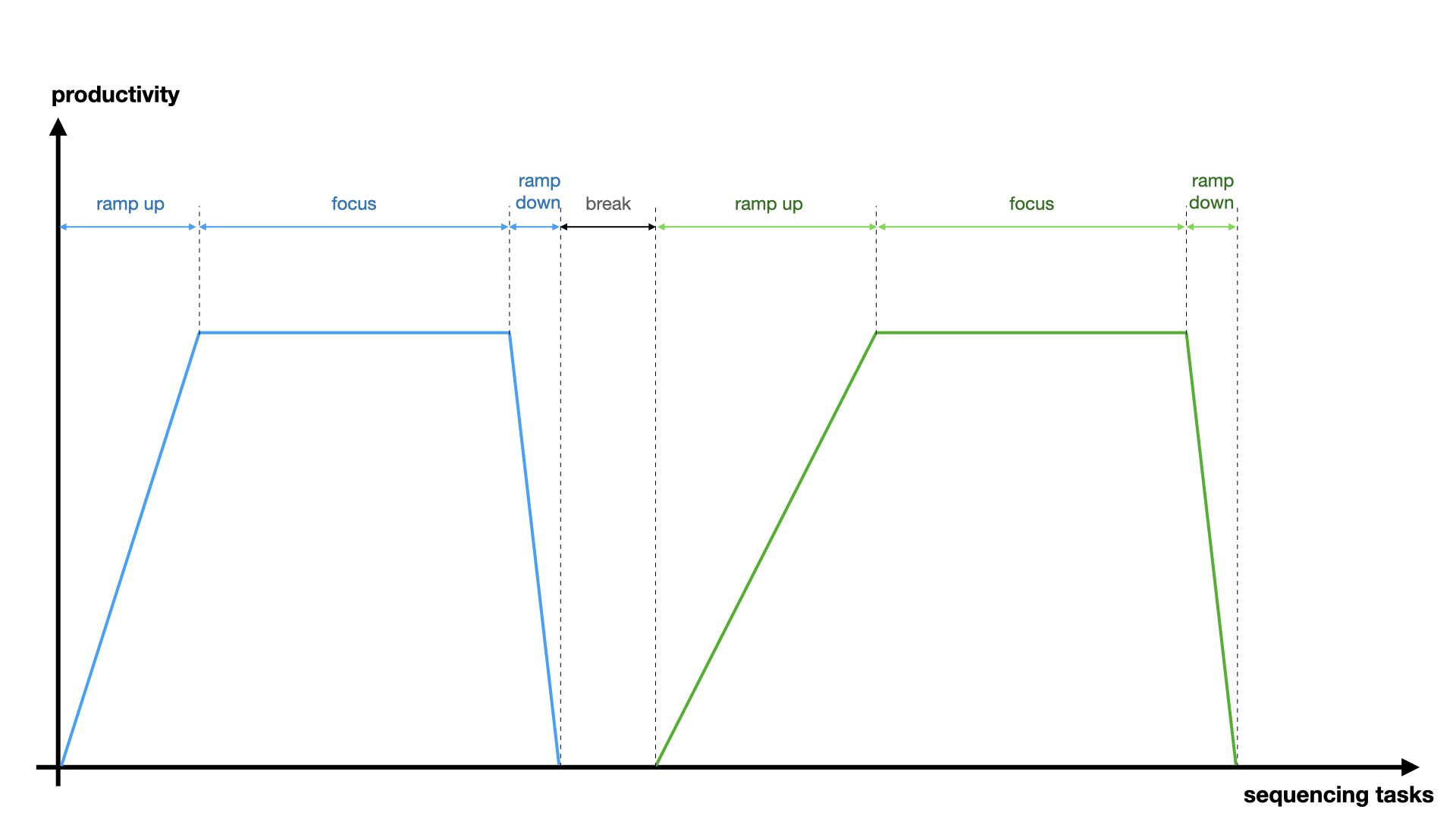
Switch tasking is not multitasking with a more accurate label. It is a fundamentally different description of what is actually happening cognitively when we attempt to work on multiple things at once. Rather than processing tasks in parallel, the brain alternates between them. This results in cycling through a recurring sequence of ramping onto a task, sustaining focused attention, and ramping off before redirecting cognitive resources to the next task in rotation.
This switching happens quickly and efficiently for tasks that are simple, well-practiced, and highly automated. The cognitive overhead is minimal, and the inefficiency introduced by alternation is small enough to be practically negligible. This is the narrow domain in which something resembling productive multitasking actually exists.
But the story is different for tasks that are New, Unique, Different, or Difficult (NUDD). These are tasks that require active working memory, deliberate attention, and the construction and maintenance of complex cognitive context. When the brain is asked to switch between tasks of this kind, the cost is not trivial. The ramp-up required to re-engage meaningfully with a complex problem (reconstructing the mental model, re-loading the relevant context, and returning to the depth of focus where real cognitive work happens) is significant, measurable, and cumulative.
A Simple Experiment
The abstract argument for the inefficiency of switch tasking becomes apparent when tested empirically, even with a deliberately simple example. Take a piece of paper and a timer and run the following comparison.
First, complete two sequential tasks without alternating: write the alphabet from A to Z, then write the numbers 1 through 26. Record how long this takes.
Then repeat the same content, but this time alternate between the two tasks with every entry: A, 1, B, 2, C, 3, and so on through Z and 26. Record how long this takes.
In years of running this exercise across a wide range of professionals, the result is almost without exception the same: the alternating version takes meaningfully longer than the sequential version. The alphabet is not a complex task. Neither is counting. And yet the switching itself introduces inefficiency that is immediately, personally measurable.

Now consider what happens when the tasks being alternated are not simple, over-learned sequences but genuinely complex, contextually rich work requiring sustained concentration. The ramp-up and ramp-down overhead associated with each switch does not shrink as task complexity increases. It grows. The cognitive cost of reconstructing a sophisticated mental model after an interruption, of re-establishing the thread of a nuanced analysis, of returning to a creative or technical flow state that took twenty minutes to enter. These costs are orders of magnitude larger than the overhead incurred by switching between the alphabet and a number sequence.

The cumulative consequence, across a workday filled with context switches, is a substantial and largely invisible tax on productivity. Work takes longer. Quality suffers. The depth of thinking that the most important problems deserve is perpetually crowded out by the fragmentation of attention.
The Architecture of Intentional Focus
If switch tasking is the enemy of deep, high-quality cognitive work, the antidote is structural rather than aspirational. Internally thinking about increasing focus is not, on its own, an effective strategy in an environment architected around interruption. The solution requires deliberately designing the conditions under which sustained, uninterrupted attention becomes possible.
This looks different for different roles, different organizational contexts, and different personal working styles. But the underlying principle is consistent:
protect blocks of time that are explicitly dedicated to single-task deep work, and treat the integrity of those blocks with the same seriousness that you would treat a commitment to an escalation
A meeting that is scheduled and then canceled imposes a cost. An uninterrupted work block that is fragmented by notifications, ad hoc questions, and reactive task switching imposes a cost that is less visible but no less real. This is amplified by a corporate culture which values Bias for Reaction as a signal of value.
Practical approaches vary in their specifics but share a common architecture: time-blocking on the calendar to create explicit single-task windows, managing notification environments to reduce the ambient interruption load, communicating availability norms to colleagues so that the expectation of instant response does not structurally preclude focused work, and batching reactive tasks into defined windows rather than allowing them to colonize the entire day. None of these approaches require heroic discipline or radical departures from normal professional behavior. They require, primarily, the recognition that how time is structured determines the quality of work that time can produce.
An Honest Audit
The most productive starting point for anyone who wants to take this seriously is not a new system or a new tool but an honest, qualitative assessment of how attention is currently being spent. On a typical workday, how many genuinely complex tasks are being actively alternated between? How frequently does a piece of important work get interrupted before it reaches the depth where the most valuable thinking happens? How critical are the interruptions and are they worth the interruption? How much of the day is structured around sustained focus, and how much is structured around availability and responsiveness?
The answers to these questions, for most people in most modern professional environments, are uncomfortable. The good news is that the gap between current practice and meaningfully improved practice is not as large as it might seem. Even modest structural changes to how attention is managed (e.g. protecting two focused hours in a morning, batching communication into defined windows, finishing one complex task before opening another) tend to produce disproportionate improvements in the quality and quantity of output.
Switch tasking is not a character flaw or a failure of discipline. It is a default behavior that emerges naturally from environments that optimize for availability over depth, Bias for Reaction over proactive in-depth work. Changing the output requires changing the environment, and changing the environment starts with clearly seeing the cost of the current one.
I boil this down to an acronym to be a reminder during my professional hours: L=M!=P (to be discussed in a later post).
How much of your productive capacity do you think is lost to switch tasking on a typical day? And what structural changes have you found most effective for protecting focused, uninterrupted work time?
